Maine Coon Cat: Size, Personality, Health and Care
The Maine Coon is a large, longhaired cat from New England and one of the most popular pedigreed breeds in the US. Males can reach 20 pounds or more, the breed can take three years or more to reach full size, and it is known for a gentle, playful temperament. The main inherited conditions breeders test for are hypertrophic cardiomyopathy (HCM), spinal muscular atrophy (SMA) and hip dysplasia.
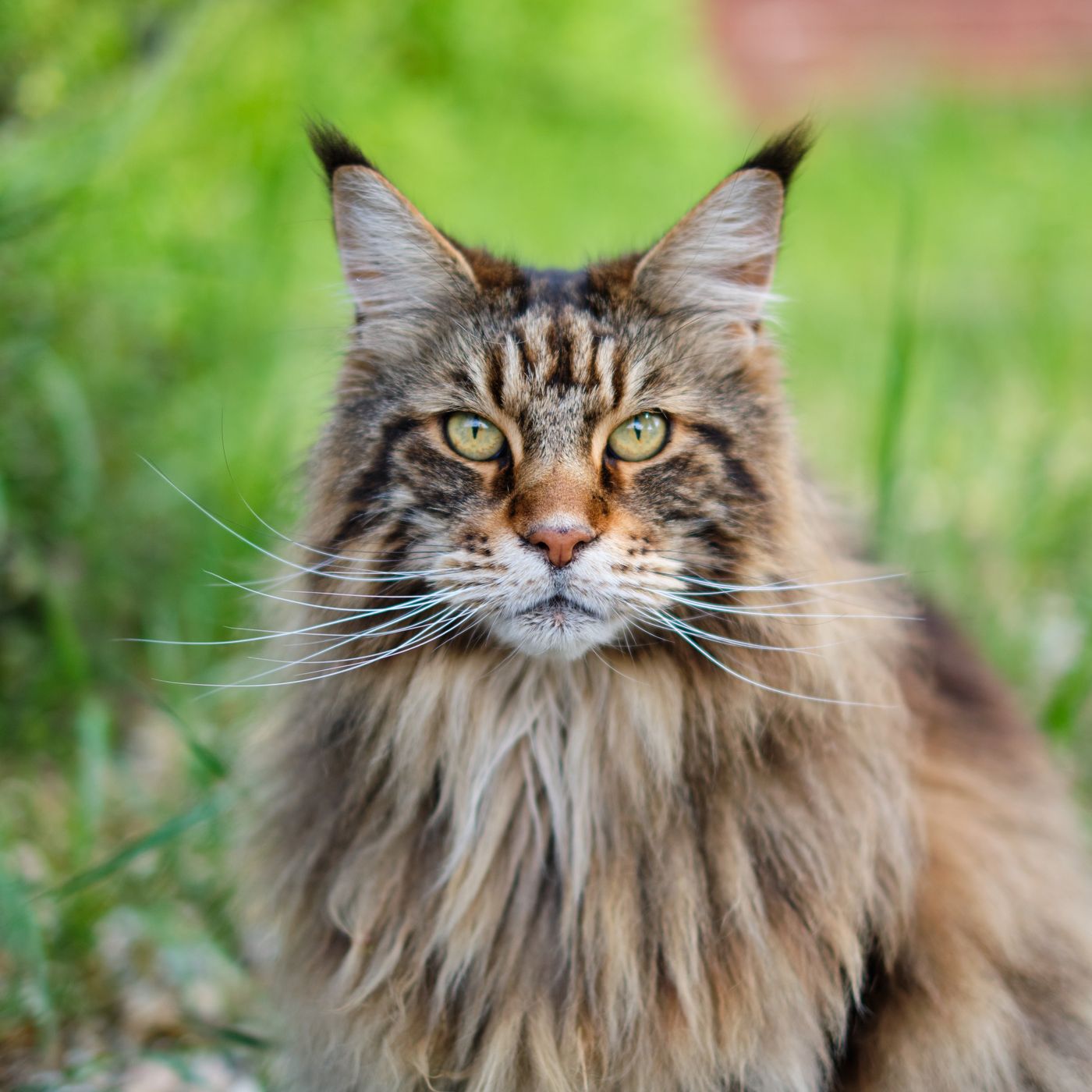
Maine Coon Quick Facts
| Origin | Maine, United States |
|---|---|
| Size | Large |
| Weight, females | About 9 to 15 lb (4 to 7 kg) |
| Weight, males | About 13 to 22 lb (6 to 10 kg); some exceed 20 lb |
| Full size reached | Up to 3 years (CFA); 3 to 5 years (TICA) |
| Coat | Long, heavy and shaggy; longer on the sides, belly and back legs |
| Grooming | Comb two or three times a week |
| Activity level | Moderate to high; playful into adulthood |
| With children and other pets | Generally good |
| Life expectancy | 9.7 years in a UK study of cats under veterinary care (see below) |
| DNA tests available | HCM (MYBPC3 A31P), SMA, pyruvate kinase deficiency |
| CFA ranking | No. 1 most popular breed for 2026 |
Where the Maine Coon Comes From
The Maine Coon is America's native longhaired breed and the official state cat of Maine (TICA). The Cat Fanciers' Association (CFA) traces its documented history to the 1850s and notes that it was shown at the first US cat show in 1895 (CFA). The breed developed as a working farm and ship cat in a cold climate, which explains the water resistant coat, large paws and bushy tail.
The old story that the breed came from cats mating with raccoons is genetically impossible, as CFA points out. Most breeders believe it descends from shorthaired domestic cats crossed with longhaired cats brought from overseas (TICA). CFA granted the breed Championship status in 1976, and it has ranked among CFA's ten most registered breeds for years. In CFA's ranking for 2026 it was number one (CFA).
How Big Do Maine Coons Get?
Maine Coons are among the largest pedigreed cats. CFA says mature males can reach or exceed 20 pounds and that females are usually smaller (CFA). TICA's breed page gives two sets of figures: an average of 9 to 13 lb for females and 13 to 18 lb for males, and healthy weights of about 12 to 15 lb for females and 18 to 22 lb for males (TICA).
They also grow slowly. CFA says growth can take up to three years and TICA says three to five, so a one year old cat that looks "done" often still has growing to do. Weight alone does not tell you whether a cat is the right size; your veterinarian can check body condition.
Maine Coon Personality and Energy Level
CFA describes the breed as gentle and easygoing yet active (CFA). CFA describes a sociable, intelligent cat, and TICA says it tends to follow its people from room to room without demanding constant attention. Many learn to fetch, solve puzzle toys and walk on a leash.
Maine Coons are not especially talkative. They are better known for chirps and trills than for loud meowing. Both CFA and TICA describe them as generally good with children, dogs and other cats, though their size can surprise a small child or another pet at first. Many are curious about water and will bat at a dripping tap.
Activity level stays fairly high into adulthood. A Maine Coon needs daily play and room to climb; tall, sturdy cat trees matter more for this breed than for a small cat.
Maine Coon Health Problems: What Is Inherited
International Cat Care notes that breeds with long lists of known conditions are often the ones that have been studied and tested most, not necessarily the ones with the most problems (International Cat Care). For the Maine Coon, three inherited conditions come up most.
Hypertrophic Cardiomyopathy (HCM)
HCM thickens the heart muscle. In Maine Coons it is linked to a variant called A31P in the MYBPC3 gene. According to the UC Davis Veterinary Genetics Laboratory, roughly one third of Maine Coons tested carry one or two copies (UC Davis VGL). Cats with one copy have about 1.8 times the relative risk of HCM of cats without it, and cats with two copies about 18 times the risk.
The variant does not explain every case. UC Davis notes that Maine Coons without it can still develop HCM. CFA says breeders test for HCM with both saliva (DNA) tests and echocardiograms (CFA).
Spinal Muscular Atrophy (SMA)
SMA causes the loss of nerve cells in the lower spinal cord, which weakens the hind leg muscles. Signs usually appear at three to four months of age as an unsteady gait. UC Davis describes it as neither painful nor fatal; affected cats can live comfortably indoors. It is recessive, so a kitten needs two copies to be affected, and a DNA test identifies carriers (UC Davis VGL).
Hip Dysplasia
Hip dysplasia is a malformation of the hip joint. In a study of 2,548 Maine Coons in the Orthopedic Foundation for Animals registry, 24.9% had hip dysplasia on X-ray, with a slightly higher rate in males (27.3%) than in females (23.3%) (Loder and Todhunter, 2018). The authors caution that registry cats may not represent every Maine Coon. CFA notes that breeders screen for it by X-ray.
Other Screening
TICA lists pyruvate kinase deficiency and luxating patella among the conditions some breeders also screen for (TICA). When buying a kitten, ask the breeder which tests the parents have had and ask to see the results.
How Long Do Maine Coons Live?
A 2024 study of cats under veterinary care in the UK estimated a life expectancy at birth of 9.71 years for Maine Coons, compared with 11.89 years for crossbred cats (Teng et al., 2024). The figure comes from UK veterinary records and may not match cats elsewhere. Many individual Maine Coons live well beyond it.
Grooming and Care
Despite the long coat, the Maine Coon is not a high maintenance breed. CFA recommends combing two or three times a week for five to ten minutes to limit shedding, mats and hairballs. Most do not need regular baths (CFA). TICA adds that a cottony coat needs more frequent combing than a silky one and recommends nail trims every two to three weeks and regular tooth brushing (TICA).
Some Maine Coons are polydactyl, meaning they are born with extra toes. TICA identifies these cats as Maine Coon Polydactyls (TICA).
Feeding a Maine Coon
A big cat needs more calories, but not as many as owners often expect. Using the standard veterinary formula, a neutered 15 lb Maine Coon needs roughly 354 kcal a day and a neutered 20 lb cat roughly 439 kcal. TICA notes that the breed tends to gain weight after spaying or neutering (TICA), so measure portions instead of free feeding and recheck weight every few weeks. Our daily feeding guide shows how to turn calories into cups.
Look for a named animal protein in the first ingredients; our ingredients to look for guide explains what scores highest. You can compare dry cat foods by ingredients on our home page.
Maine Coon FAQ
How big is a full grown Maine Coon?
Females usually weigh about 9 to 15 lb and males about 13 to 22 lb. Some males pass 20 lb. Most reach full size at three years of age or later.
Are Maine Coons good family cats?
CFA and TICA both describe the breed as gentle and sociable and generally good with children, dogs and other cats.
What health problems do Maine Coons have?
The best known inherited conditions are hypertrophic cardiomyopathy, spinal muscular atrophy and hip dysplasia. DNA tests exist for the HCM variant A31P and for SMA.
How long do Maine Coons live?
A 2024 UK study estimated 9.71 years at birth for Maine Coons under veterinary care. Individual cats often live longer.
Do Maine Coons shed a lot?
They shed, especially seasonally. Combing two or three times a week keeps shedding and mats under control.
Sources
- CFA, Maine Coon Cat
- CFA, Most Popular Breeds for 2026
- TICA, Maine Coon
- UC Davis Veterinary Genetics Laboratory, Hypertrophic Cardiomyopathy (HCM) in Maine Coons
- UC Davis Veterinary Genetics Laboratory, Spinal Muscular Atrophy (SMA) in Maine Coon Cats
- International Cat Care, Inherited Disorders in Cats
- Loder RT, Todhunter RJ. Demographics of hip dysplasia in the Maine Coon cat. Journal of Feline Medicine and Surgery, 2018;20(4):302 to 307
- Teng KT, Brodbelt DC, Church DB, O'Neill DG. Life tables of annual life expectancy and risk factors for mortality in cats in the UK. Journal of Feline Medicine and Surgery, 2024;26(5)