Persian Cat: Size, Personality, Health and Care
The Persian is a medium sized, longhaired cat with a round head, a short nose and a calm, quiet temperament. Adult males in a large UK study averaged about 9.5 lb and females about 7.5 lb. The main inherited concerns are polycystic kidney disease (PKD), problems linked to the flat face (brachycephaly) and an early onset form of progressive retinal atrophy (PRA).
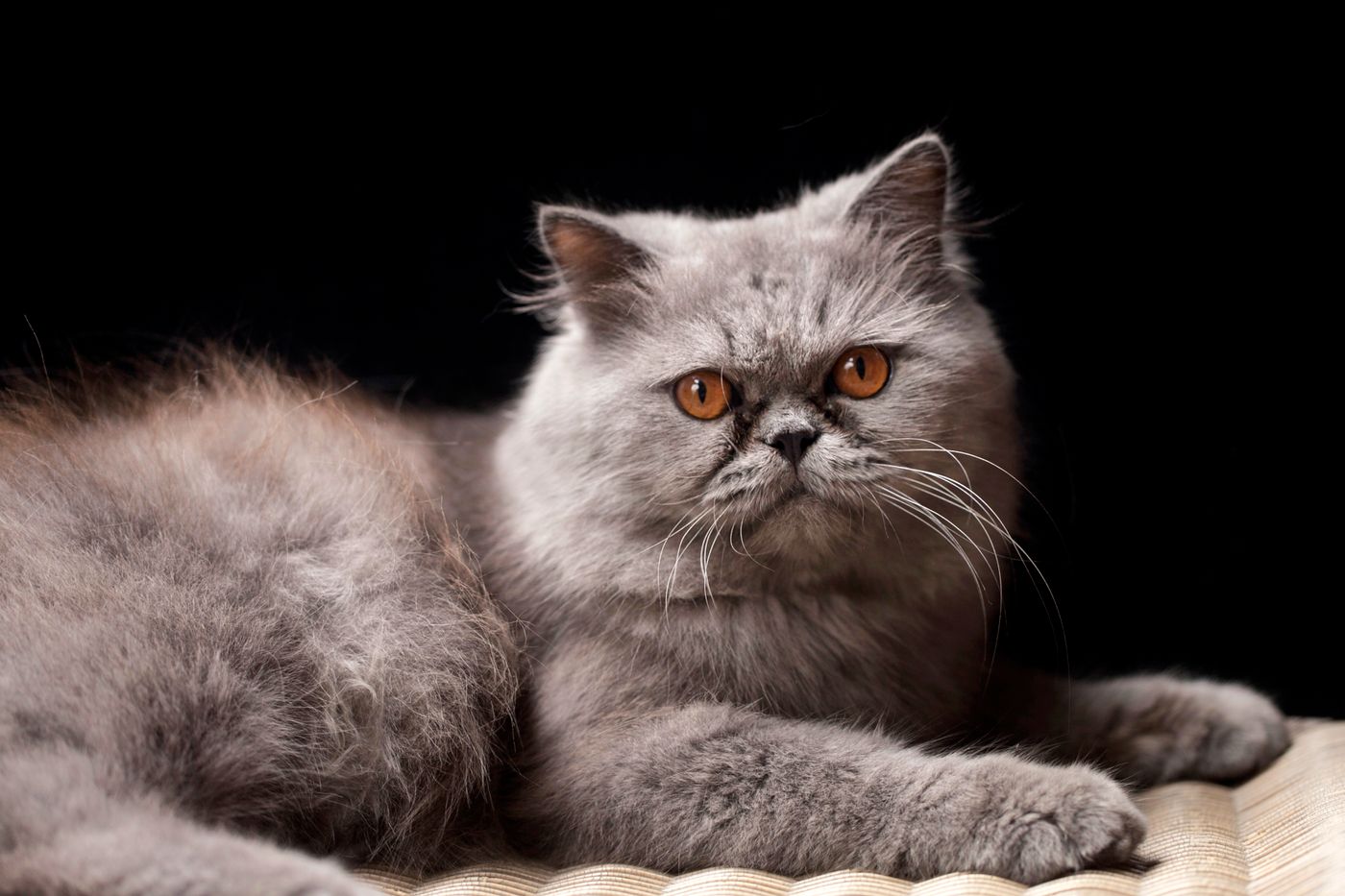
Persian Quick Facts
| Origin | Persia (presumed); modern type developed in Britain |
|---|---|
| Size | Medium; looks larger because of the coat |
| Weight, females | About 7.5 lb (3.4 kg) on average |
| Weight, males | About 9.5 lb (4.3 kg) on average |
| Coat | Long and thick, with a full ruff and a plumed tail |
| Grooming | Comb daily, bathe regularly and wipe the eyes every day |
| Activity level | Low to moderate; placid with bursts of play |
| With children and other pets | Generally good with gentle children and other pets |
| Life expectancy | 10.9 years in a UK study of cats under veterinary care (see below) |
| DNA tests available | PKD1, PRA-pd (AIPL1) |
| CFA ranking | No. 3 most popular breed for 2026 |
Where the Persian Comes From
CFA says the breed takes its name from its presumed homeland. In 1626 the Italian trader Pietro della Valle brought a heavily coated longhaired cat back from Persia (CFA). Persians were among the first cats shown in Britain, where breeders in the late 1800s shaped the modern standard. By 1900 Americans were importing Persians from Britain (TICA).
The Persian was one of the six foundation breeds when CFA started in 1906 (CFA). CFA shows Persians in seven color divisions, one of which is the pointed Himalayan. TICA instead registers the Himalayan as its own breed within a Persian Breed Group that also includes the Exotic Shorthair (TICA). In CFA's ranking for 2026 the Persian was number three (CFA).
How Big Is a Persian?
The Persian has heavy bone, a broad chest and short legs. TICA calls it a medium sized cat that looks larger because of its coat, and says males are bigger than females (TICA). CFA's standard asks for a cat that is "medium to large" and states that quality matters more than size (CFA standard).
Neither registry publishes weights. A study of 3,235 Persians seen at UK general practices found that adult males averaged 4.3 kg (about 9.5 lb) and adult females 3.4 kg (about 7.5 lb) (O'Neill et al., 2019). Your veterinarian can check body condition.
Persian Personality and Energy Level
CFA describes Persians as sweet and quiet and calls them "playful yet placid." It also says they are one of the easiest breeds to train and are not likely to climb the drapes or raid the kitchen counter (CFA). TICA describes a gentle, easygoing cat that prefers calm surroundings and adapts well to a new home. Persians communicate mostly with their eyes and a soft voice (TICA).
Energy is low to moderate. TICA mentions bursts of kitten-like play but says owners may need to encourage daily exercise. CFA calls the breed compatible with children of all ages and able to live peacefully with other pets. TICA adds that Persians enjoy being combed and petted by children but are unlikely to join in rough play.
Persian Health Problems: What Is Inherited
International Cat Care notes that breeds with long lists of known conditions are often the ones with more monitoring and testing (International Cat Care). For the Persian, three issues come up most.
Polycystic Kidney Disease (PKD)
PKD causes cysts in the kidneys, which often lead to kidney failure later in life. The UC Davis Veterinary Genetics Laboratory describes the PKD1 variant as autosomal dominant: one copy causes the disease, and an affected cat passes it to about half of its kittens. Cysts often appear before 12 months of age. UC Davis estimates that over 37% of Persians have the variant and notes that many breeders have lowered its frequency through screening (UC Davis VGL).
International Cat Care advises buyers to ask for proof of a negative test (International Cat Care). A negative result means the cat does not have this inherited form, but UC Davis points out that kidney cysts can still occur sporadically in any cat.
Brachycephaly and the Flat Face
Persians are bred for a short, flat face. International Cat Care says many have small nostrils and a soft palate that is too long, and that brachycephalic obstructive airway syndrome (BOAS) is common in the breed. The exposed eyes are prone to keratitis and corneal sequestrum, deformed tear ducts cause tear staining, and the short jaw can misalign the teeth (International Cat Care; International Cat Care).
A UK study of 3,235 Persians recorded eye discharge in 5.8% and periodontal disease in 11.3%, but found no evidence of a respiratory predisposition. The authors note that some owners may see noisy breathing as normal for the breed and never take the cat to a veterinarian for it (O'Neill et al., 2019). CFA's standard requires nostrils open enough for the cat to breathe without restriction, and CFA says breeders reduced breathing problems by removing cats with smaller than average nostrils from breeding programs (CFA standard; CFA). Ask a breeder about the parents' breathing and nostril size, and have your veterinarian check a new kitten's airway and eyes.
Progressive Retinal Atrophy (PRA-pd)
A recessive form of PRA in Persians is caused by a variant in the AIPL1 gene. According to UC Davis, loss of retinal cells begins at around 5 weeks of age and is severe by 16 weeks. The end result is blindness. A kitten must inherit two copies to be affected. Carriers have normal vision but can pass the variant on, and the test covers this Persian variant only (UC Davis VGL).
Other Screening
TICA advises owners to ask their breeder and veterinarian about screening for hypertrophic cardiomyopathy (HCM) and respiratory problems as well as PKD and PRA (TICA). In the 2019 UK study, kidney disease was the most common cause of death, at 23.4% of deaths with a recorded cause (O'Neill et al., 2019).
How Long Do Persians Live?
A 2024 study of cats under veterinary care in the UK estimated a life expectancy at birth of 10.93 years for Persians, compared with 11.89 years for crossbred cats (Teng et al., 2024). The figure comes from UK veterinary records and may not match cats elsewhere. Many individual Persians live well beyond it; an earlier UK study found a median age at death of 13.5 years (O'Neill et al., 2019). TICA gives a typical range of 8 to 11 years (TICA).
Grooming and Care
The Persian coat is a daily job. TICA recommends combing every day with a metal comb to prevent mats and hairballs, bathing regularly from kittenhood and using a conditioner so the coat does not dry out. Soft, cottony coats, common in dilute colors such as blue and cream, mat and stain more easily (TICA). CFA says owning a Persian "calls for a serious commitment to regular grooming" and notes that many pet owners rely on professional groomers (CFA).
The face needs care as well. Wipe the eyes daily with a soft, damp cloth and clean the face regularly to limit tear stains. TICA recommends nail trims weekly for kittens and every two to three weeks for adults, plus regular tooth brushing (TICA).
Feeding a Persian
Using the standard veterinary formula, a neutered 8 lb Persian needs roughly 221 kcal a day and a neutered 10 lb cat roughly 261 kcal. TICA notes that Persians tend to gain weight after spaying or neutering and that owners should watch both the quality and the quantity of food (TICA). Our daily feeding guide shows how to turn calories into cups.
TICA says many Persians do better with a water fountain, which keeps the chin and chest fur drier. Look for a named animal protein in the first ingredients; our ingredients to look for guide explains what scores highest. You can compare dry cat foods by ingredients on our home page.
Persian FAQ
How big is a full grown Persian?
Adult Persians in a UK study averaged about 9.5 lb for males and 7.5 lb for females. They look bigger than that because of the long coat.
Are Persians good family cats?
CFA calls them compatible with children of all ages and other pets. They prefer a calm home and gentle handling and are unlikely to join rough play.
What health problems do Persians have?
The best known are polycystic kidney disease, breathing and eye problems linked to the flat face, and an early onset form of progressive retinal atrophy. DNA tests exist for PKD1 and PRA-pd.
How long do Persians live?
A 2024 UK study estimated 10.93 years at birth for Persians under veterinary care. Individual cats often live longer.
Do Persians need a lot of grooming?
Yes. The long coat needs daily combing and regular baths, and the eyes need wiping every day.
Sources
- CFA, Persian
- CFA, Persian Breed Standard (PDF)
- CFA, Most Popular Breeds for 2026
- TICA, Persian
- UC Davis Veterinary Genetics Laboratory, Polycystic Kidney Disease (PKD1)
- UC Davis Veterinary Genetics Laboratory, Progressive Retinal Atrophy (PRA-pd) (Persian)
- International Cat Care, Persian Cats and Brachycephaly
- International Cat Care, Runny Eyes
- International Cat Care, Inherited Disorders in Cats
- O'Neill DG, Romans C, Brodbelt DC, et al. Persian cats under first opinion veterinary care in the UK: demography, mortality and disorders. Scientific Reports, 2019;9:12952
- Teng KT, Brodbelt DC, Church DB, O'Neill DG. Life tables of annual life expectancy and risk factors for mortality in cats in the UK. Journal of Feline Medicine and Surgery, 2024;26(5)