Ragdoll Cat: Size, Personality, Health and Care
The Ragdoll is a large, semi-longhaired cat with blue eyes, developed in California in the 1960s and now one of the most registered breeds in the US. Males usually weigh 15 to 20 pounds, the breed can take up to four years to reach full size, and it is known for a calm, affectionate temperament. The main inherited condition breeders test for is hypertrophic cardiomyopathy (HCM), linked in this breed to a variant called R820W.
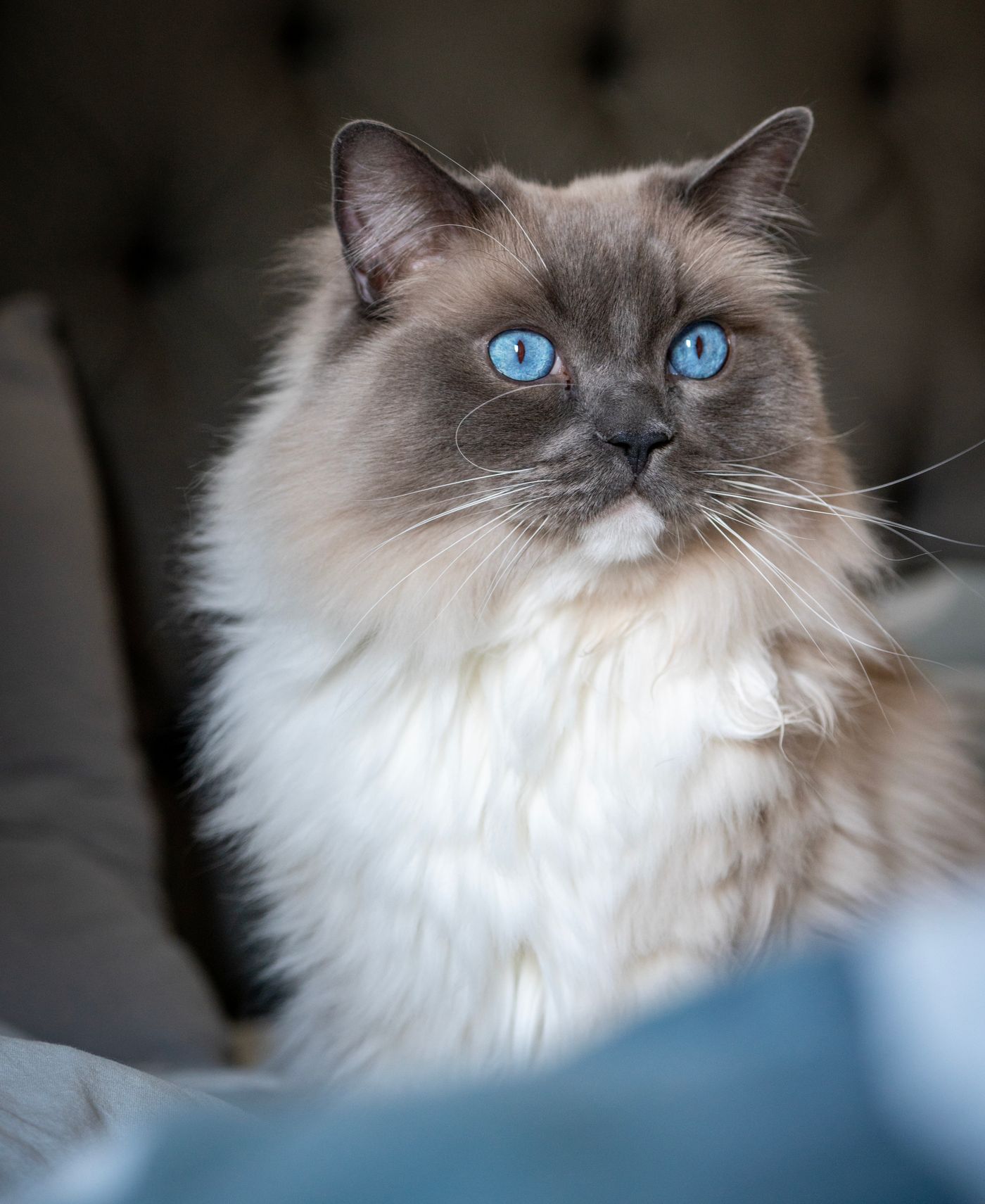
Ragdoll Quick Facts
| Origin | Riverside, California, United States |
|---|---|
| Size | Large |
| Weight, females | About 10 to 15 lb (4.5 to 7 kg) |
| Weight, males | About 15 to 20 lb (7 to 9 kg); some exceed 20 lb |
| Full size reached | Up to 4 years |
| Coat | Semi-long, silky and soft; pointed pattern with blue eyes |
| Grooming | Comb once or twice a week |
| Activity level | Moderate; playful but not demanding |
| With children and other pets | Generally good |
| Life expectancy | 10.3 years in a UK study of cats under veterinary care (see below) |
| DNA tests available | HCM (MYBPC3 R820W); PKD1 is also offered for the breed |
| CFA ranking | No. 2 most popular breed for 2026 |
Where the Ragdoll Comes From
The Ragdoll was developed in the early 1960s by Ann Baker, a breeder in Riverside, California (TICA). The foundation cat was Josephine, a white longhaired cat that carried the colorpoint gene (CFA). TICA names two more early cats, a seal point mitted male called Daddy Warbucks and a solid black cat called Blackie. Baker told an unusual story about Josephine's genes being changed after a car accident; TICA repeats it as her claim, not as fact.
Breeders Denny and Laura Dayton later split from Baker and worked to have the breed recognized by the major registries. TICA accepted the Ragdoll for championship competition when the association began in June 1979 (TICA). CFA accepted it for registration in 1993 and granted championship status in 2000 (CFA). The breed was number one in CFA's 2023 registration data (CFA via PR Newswire) and number two in its ranking for 2026 (CFA).
How Big Do Ragdolls Get?
Ragdolls are among the larger pedigreed cats, with a broad chest and heavy boning. TICA gives typical adult weights of 15 to 20 lb for males and 10 to 15 lb for females (TICA). CFA says mature males can reach or exceed 20 pounds and that females are usually smaller (CFA).
The breed matures slowly. TICA says a Ragdoll may take up to four years to reach full size and weight, and that full color does not appear until about three years of age. A young adult that still looks lean may simply not be finished growing. Your veterinarian can tell you whether your cat's body condition is right for its age.
Ragdoll Personality and Energy Level
CFA describes the Ragdoll as docile, placid and affectionate, a cat that is loving without being demanding (CFA). Many greet their owners at the door, stay close around the house and sleep with them. TICA notes that they often go limp when cuddled and that they are sometimes called "puppy cats" because they follow people from room to room (TICA).
Ragdolls are quiet cats. CFA says they are not talkative and may give a soft mew. Some learn to fetch or come when called.
Activity level is moderate. CFA says they enjoy play sessions but do not insist on them, and that they adapt to most homes without needing much space. TICA adds that kittens and young adults can be rambunctious, and that the breed may not suit a family looking for a very active or vocal cat. Both registries describe Ragdolls as good with children and other pets. CFA points out that their trusting nature means introductions to a resident cat or dog should be made with care.
Ragdoll Health Problems: What Is Inherited
International Cat Care notes that a breed with several identified conditions often reflects more monitoring and testing, not necessarily a higher rate of inherited disease (International Cat Care). For the Ragdoll, one inherited condition comes up most.
Hypertrophic Cardiomyopathy (HCM)
HCM thickens the walls of the heart muscle, and the Cornell Feline Health Center calls it the most common heart disease of cats. Cornell lists the Ragdoll among the breeds in which it is more prevalent (Cornell Feline Health Center).
In Ragdolls, HCM is linked to a variant called R820W in the MYBPC3 gene. UC Davis describes the inheritance as autosomal dominant with incomplete penetrance (UC Davis VGL). Cats with two copies are at high risk of severe HCM, usually between one and two years of age, and have a greater likelihood of early cardiac death. Cats with one copy may be at increased risk of HCM, but they are not likely to show signs of the disease and may live a normal lifespan. In a worldwide study of 1,855 cats from 28 breeds and randombred cats, the R820W variant was found only in Ragdolls (Longeri et al., 2013). UC Davis now also offers the test for the Ragamuffin and reports that the variant has been detected in the American Bobtail (Longhair), Highlander and Munchkin.
The DNA test detects only R820W, and Cornell notes that not every cat with a variant develops the disease. HCM itself is diagnosed by echocardiography. CFA says breeders test routinely and are working to remove carrier cats from the breeding pool (CFA). Ask the breeder for the parents' DNA results and any heart scans.
Polycystic Kidney Disease (PKD)
UC Davis lists the Ragdoll among the Persian-derived breeds for which its PKD1 DNA test is offered (UC Davis VGL). PKD1 is autosomal dominant, so one copy is enough to cause cysts in the kidneys. The registries' Ragdoll pages do not list PKD as a breed concern, so ask a breeder or veterinarian whether the test is relevant for a particular line.
How Long Do Ragdolls Live?
A 2024 study of cats under veterinary care in the UK estimated a life expectancy at birth of 10.31 years for Ragdolls, compared with 11.89 years for crossbred cats (Teng et al., 2024). The figure comes from UK veterinary records and may not match cats elsewhere. It is an average at birth, so many individual Ragdolls live longer.
Grooming and Care
The Ragdoll coat has mostly guard hairs and little undercoat, which gives it a silky feel and makes it less prone to matting than some longhaired coats. CFA recommends combing at least once or twice a week with a steel comb (CFA). Ragdolls still shed, mainly in spring and fall. TICA suggests brushing down to the skin, not just over the top of the coat, with a stainless steel comb (TICA).
TICA also recommends trimming nails about once a month and having teeth checked at the annual veterinary visit. Ragdolls can be trained from a young age to accept baths. Ask your breeder which products to use.
Feeding a Ragdoll
A large cat needs more calories than an average cat, but a calm one burns fewer than its size suggests. Using the standard veterinary formula, a neutered 12 lb Ragdoll needs roughly 299 kcal a day and a neutered 18 lb cat roughly 406 kcal. CFA says the breed is known for its love of food and may be at risk of obesity, and advises watching portion sizes (CFA). TICA notes that obesity can lead to problems such as diabetes, suggests checking body condition along the spine and ribs, and says interactive play helps limit weight gain (TICA). Our daily feeding guide shows how to turn calories into cups.
Look for a named animal protein in the first ingredients; our ingredients to look for guide explains what scores highest. You can compare dry cat foods by ingredients on our home page.
Ragdoll FAQ
How big is a full grown Ragdoll?
Males usually weigh about 15 to 20 lb and females about 10 to 15 lb. Some males pass 20 lb. Ragdolls can take up to four years to reach full size.
Are Ragdolls good family cats?
CFA and TICA both describe the breed as gentle and affectionate and generally good with children and other pets. They are quiet and only moderately active.
What health problems do Ragdolls have?
The best known inherited condition is hypertrophic cardiomyopathy, linked in this breed to the MYBPC3 R820W variant. A DNA test exists for it.
How long do Ragdolls live?
A 2024 UK study estimated 10.31 years at birth for Ragdolls under veterinary care. Individual cats often live longer.
Do Ragdolls shed a lot?
They shed, mostly in spring and fall. CFA links the lack of a dense undercoat to reduced shedding and matting, and weekly combing keeps it under control.
Sources
- CFA, Ragdoll
- CFA, Most Popular Breeds for 2026
- CFA press release on 2023 registrations (top 15), via PR Newswire, February 2024
- TICA, Ragdoll
- UC Davis Veterinary Genetics Laboratory, Hypertrophic Cardiomyopathy (HCM) in Ragdolls
- UC Davis Veterinary Genetics Laboratory, Polycystic Kidney Disease (PKD1)
- Cornell Feline Health Center, Hypertrophic Cardiomyopathy
- International Cat Care, Inherited Disorders in Cats
- Longeri M, Ferrari P, Knafelz P, et al. Myosin-binding protein C DNA variants in domestic cats (A31P, A74T, R820W) and their association with hypertrophic cardiomyopathy. Journal of Veterinary Internal Medicine, 2013;27(2):275 to 285
- Teng KT, Brodbelt DC, Church DB, O'Neill DG. Life tables of annual life expectancy and risk factors for mortality in cats in the UK. Journal of Feline Medicine and Surgery, 2024;26(5)